Is New Braunfels a Good Place to Retire?

Is New Braunfels a Good Place to Retire? The Honest Answer
Taxes, healthcare, 55+ communities, heat, and the stuff nobody at the retirement seminar mentions.
By Joe Hurd · 830.580.3667 · buyfromjoehurd.com
Yes, for the right person. No, for the wrong one. I'd rather tell you which one you are before you rent a U-Haul.
The short answer
New Braunfels suits you if you want river-town energy, a real downtown, German food, and a short drive to a big airport and big hospitals. It suits you if you can handle heat and don't need to walk to the grocery store.
It does not suit you if you want a quiet beach-town retirement where nothing happens and nobody visits. In summer this town is tubing central. You will hear about it, and you will sit in it on I-35.
| Good fit if you... | Probably not if you... |
|---|---|
| Want rivers, a real downtown and things to do | Want quiet, with nobody visiting |
| Like no state income tax | Are on a tight fixed income and haven't run the property tax math |
| Can live with a long, hot summer | Can't handle 100-degree stretches |
| Are fine driving to San Antonio or Austin for specialists | Need frequent specialist visits and hate traffic |
| Will keep driving for the foreseeable future | Plan to give up driving soon |
Still shopping? My New Braunfels housing market 2026 breakdown covers where prices sit right now.
Taxes: no state income tax, but read the property tax line
Texas has no state income tax. Great. Your pension, Social Security and IRA withdrawals aren't taxed at the state level.
Now the catch. Texas makes up for it with property taxes, and they're not small. Here's an illustration, not a quote for any real house:
- Combined tax rate: roughly 1.7% to 1.8%, depending on school district and any special districts
- Before exemptions: about $6,800 to $7,200 a year, or $570 to $600 a month
- 65+ with homestead and senior exemptions: roughly $4,000 to $5,000 a year, depending on the address and which exemptions apply
Sit with that for a second. Even after the senior breaks, you're paying roughly $330 to $415 a month just in property tax. That's a car payment. For a lot of retirees on Social Security, that's a real chunk of the check. Gone. Every month. That's the "no state income tax" everyone celebrates, just wearing a different hat.
And that's just the tax. We haven't talked about insurance, HOA, or the AC bill yet.
The good news for seniors is real. It just doesn't erase the number above:
- Homestead exemption. Your primary residence gets $140,000 off the school district's appraised value. Voters raised it from $100,000 with Proposition 13 in November 2025.
- Over-65 and disabled exemption. An additional $60,000 off school district value, raised from $10,000 with Proposition 11 in November 2025. Your county and city may offer their own senior exemptions on top of that. I'll pull the exact amounts for any address you're looking at.
- School tax ceiling. Once you qualify at 65, your school district tax is frozen at that year's amount for as long as you own and live in that home.
Big caveat. The ceiling freezes your school tax. It does not freeze the city, county or other taxes, so your bill can still creep up. If you're buying, run the real numbers with me first. I'll pull the actual tax rate for the address, not a guess.
What it costs to carry a home here on a fixed income
Forget the purchase price for a second. The monthly carrying cost is what decides if retirement here works. Four things:
- Property tax. See above. Still stings, doesn't it?
- Homeowners insurance. Texas insurance has been climbing, and hail is a real thing out here. Get a quote before you fall in love with a house, not after.
- HOA dues. The range is wild. River Chase runs about $250 to $300 a year. Del Webb at Veramendi runs about $3,072 a year, or $256 a month. That buys an amenity center, a social calendar and lawn service. Whether it's worth it depends on whether you'll actually use it.
- Summer utilities. July and August AC bills are real budget items, not footnotes. My house is 2,600 square feet and runs about $350 a month in summer. A smaller, newer, well-insulated single-story is kinder to your wallet, but it's still not nothing.
Property tax and insurance can eat a real chunk of what you save on state income tax. Add it up before you celebrate. I'd rather you be annoyed by this paragraph now than blindsided by your first full tax year.
Healthcare: what's in town and what means a drive
This matters more than the golf course, and people forget it until they need it.
CHRISTUS Santa Rosa Hospital New Braunfels is about 12 minutes from most of the main neighborhoods, and there are ERs and urgent care clinics within minutes of just about anywhere in town.
For routine care, you're covered. For specialized care, like certain cancer treatment, advanced cardiac care, complex surgery and some specialists, you're driving to San Antonio or Austin. "Driving to San Antonio" doesn't mean the 30 minutes Google shows you at 10 AM on a Tuesday. It means I-35. For a retiree making regular specialist visits, plan on 45 minutes to an hour each way in real conditions.
My advice: before you buy, check that your doctors and your plan work down here. A cheap house doesn't help if your cardiologist is out of network. If you have a chronic condition, that drive is a real part of the decision. I'm not going to wave it away to make the sale.
55+ communities vs. regular neighborhoods
People assume a retirement move means an age-restricted community. It doesn't have to.
Del Webb at Veramendi
The 12,000-square-foot amenity center broke ground in late 2025 and is expected to open by mid-2027. That matters, because you're paying Del Webb HOA dues now for amenities that are still under construction. A temporary Lifestyle Haus runs social events in the meantime. Ask where they are on the timeline before you commit.
Kissing Tree
It comes up in every search. It's not New Braunfels, so factor in the drive.
What you get in a 55+ community: a built-in social life, amenity centers, activities, and neighbors in the same stage of life. What you pay: HOA dues that reflect all that.
The rules are real too. It's an HOA with an age requirement, so there may be restrictions on what you can do with your own yard and house. Grandkids can visit, but there may be rules about how long they stay. Read the CC&Rs before you get excited about the pickleball courts.
Regular neighborhoods mean you can buy a single-story home, usually pay less in HOA dues, and keep a mixed-age community. You just don't get the built-in activity director.
Here's something nobody says out loud: a lot of people buy into 55+ communities because they're worried about being lonely in retirement. The events and neighbor dinners are nice. But a social calendar doesn't fix isolation if you're not the type to show up. If you're social, you'll build a life in any neighborhood. If you're not, a clubhouse won't change that. Be real with yourself about which person you are before you pay the premium.
Single-story, low-maintenance areas worth a look
Not a ranking, just a starting list. Every one of these needs a real walk-through before you believe me:
- Veramendi. Convenient location, smaller yards, less maintenance. Good fit if you don't want a big lot to deal with.
- Mayfair. Lots of amenities if you'll actually use them. If you're not a pool-and-fitness-center person, you're paying for someone else's lifestyle.
- River Chase. Beautiful Hill Country setting with some real space to it.
- Legacy at Lake Dunlap. Lake access is nice when the lake is full, but Highway 46 is a nightmare at times. Factor that into daily life.
- Weltner Farms. Similar feel to Legacy, without the lake.
- Vintage Oaks. Beautiful homes and a great Hill Country lifestyle, but you pay for it.
- The Gruene area. Character, history, live music and the river. Also tourists.
- Downtown. Walkable by New Braunfels standards, which is a low bar, but it's real. Older homes mean more maintenance.
Low maintenance means a smaller yard, a newer roof and systems, and a floor plan you can live in at 80. That means no stairs. If the primary bedroom is upstairs, your future self is going to be real annoyed with your present self. Ask me how many times I've had that conversation.
Want the whole list with my take on each neighborhood? That's what the free Neighborhood Guide is for.
Heat, tourist season and I-35
Heat. Look, this is Texas. It's hot. Last year wasn't that bad, with only a few days over 100. But we also get years where it's 100+ for close to three months straight. That's why we have AC. Winters are pretty mild, with only a few real cold snaps.
People visit in April, fall in love and sign a contract. Then August shows up like an uninvited guest who won't leave until October. You traded shoveling snow for being a prisoner of your own air conditioning for four months. If you're coming from Michigan or Minnesota, you are not ready. You think you are. You're not.
Tourist season. Tubing, Schlitterbahn, Wurstfest (10 days every November at Landa Park), Gruene Hall. The town fills up. It's good for the local economy and busy for you. A trip to H-E-B that takes 10 minutes in February takes 25 in July.
Roads and growth. There's been a lot of growth, and the roads show it. I-35, Highway 46, all of it. If your plan is to pop up to Austin for a 5 PM doctor's appointment, bring a book and a snack. You'll have time for both.
Walkability. Limited. Most of New Braunfels is a drive-everywhere town. Downtown and a few nearby spots are walkable, but your daily errands will probably involve a car. If you're planning to give up driving in 10 years, think about that now. Not later. Now.
Flood zones and insurance near the rivers
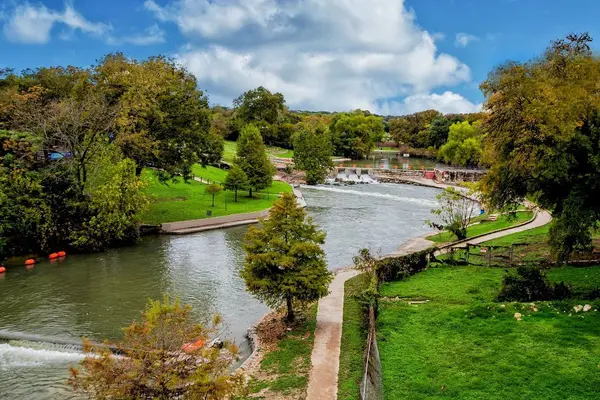
The Comal and the Guadalupe are why people move here. They're also why you check flood zones. It's Texas, so we're either feast or famine: three years of drought, then a flood. Before you buy near water:
- Check the FEMA flood map for the exact address.
- Ask what flood insurance costs. It can change a monthly payment by hundreds.
- Ask about the home's flood history.
- Standard homeowners insurance does not cover flood damage. You need a separate flood policy.
River views are lovely. Having your garage fill up with river is less lovely. Buy smart.
Selling the big house first
Most retirees I talk to are selling a bigger house somewhere else to buy here. A few pointers:
- Timing. Sell first and rent, buy first and carry two houses, or time a simultaneous closing. Each one costs something different. I'll walk through your options on a call.
- Costs. Agent fees, repairs, closing costs and moving. Plan for all of them.
- Capital gains. If you've owned and lived in your home for at least 2 of the last 5 years, you may be able to exclude up to $250,000 of gain ($500,000 if married filing jointly). Talk to a CPA about your situation.
- Moving from out of state. Coming from California, Washington or somewhere else? My Central Texas Relocation Playbook covers the move itself.
Don't let anyone rush this. The best move is the one that doesn't force you to sell cheap or buy panicked.
Quick FAQ
Is New Braunfels a good place to retire?
For people who want a river-town lifestyle, no state income tax, and solid healthcare within driving distance, yes. For people who can't stand heat or crowds, probably not.
Are there 55+ communities in New Braunfels?
Yes. Del Webb at Veramendi is the main one in New Braunfels. Kissing Tree is in San Marcos, a short drive away.
Does Texas tax retirement income?
Not at the state level, because Texas has no state income tax. You still pay property tax, and it's higher than most people expect.
Is healthcare good in New Braunfels?
Routine and emergency care is available in town, including CHRISTUS Santa Rosa Hospital New Braunfels. Specialized care often means a 45-minute to one-hour drive to San Antonio or Austin in real traffic.
What's the biggest downside of retiring in New Braunfels?
Summer heat, tourist-season traffic, I-35, and property tax plus insurance. Any one of those could rule it out for you. Do the math and visit in August before you commit.
Categories
Recent Posts